a magnificent distraction

thoughts sparked by works of literature


I read both parts of the play (although I'm not entirely sure why it's broken into two separate books, since when you finish the first one you really don't have a choice but to read the second one if you want to find out what happens with all the characters). The first part is called Millennium Approaches, and the second part is called Perestroika.

Wow. I mean, where do I begin? Kushner is addressing so many different HUGE issues. He's dealing with AIDS in the 1980's, racism, homosexuality, politics, Zionism, religion (Judaism and Mormonism, with a little bit of Catholocism sprinkled throughout), and more. I feel somewhat overwhelmed as I try to construct some sort of coherent blog post. I'll start somewhere easy: the characters. Kushner's merciless. His characters either seem to be saintly (as in the case of Prior Walter and Belize) or sinnerly (as in the case of Joe Pitt and Roy Cohn). I'll admit that one of my favorite characters was actually Harper Pitt, Joe's wife, because of her perceived insanity (when she's actually one of the most sane characters in the play). Despite some pretty severe flaws, most of these characters are surprisingly likable. I think Kushner isn't interested in villainizing anyone -- I think he's more interested in exposing some of the tangled and complex aspects of human beings, and digging into some of the issues that arise from those complexities.

The central focus of the play really becomes AIDS, not because of the disease itself, but because of the way it plays out in the characters' lives. The idea that it's some sort of shameful disease that one should cover up arises in Roy Cohn's character...but he's also the most reprehensible character there is in this play, so when we see him trying to pass AIDS off as cancer it comes off as a negative action. And of course, through his interactions with Belize (especially regarding his stash of mega-elite drugs) we get more of an idea about how widely AIDS is really affecting people. Of course, we get this from the several direct comparisons between AIDS and the Black Plague (most blatantly when Prior Walter's ancestors visit him).

Man, I'm at a total loss as to how to tackle this play. Suffice it to say it's a really powerful, intelligent, and scathing work that tackles some huge issues and forces the reader to confront issues that are not always openly addressed. Also, Kushner's use of "split" scenes (in which some characters are in one location interacting with each other while other characters are located elsewhere on the stage, but are also interacting with each other -- both groups oblivious to the other) is a really interesting technique that allows him to create interaction between different characters and different situations, but through staging and line alternation a whole new message emerges out of the side-by-side action.

I'd heard of the Zoot Suit Riots before reading this play, but I didn't know a whole lot about them. To be honest, I didn't even know where they happened (which is quite appalling, considering I'm from Southern California and all)...which makes me wonder about the aims of American education. But shifting my focus a bit...

Formally, I really enjoyed this play. It was interesting and thought-provoking, and I thought Valdez employed some very fresh strategies throughout. Plays that are based on historical events run the risk of being kind of flat -- sort of reporting the facts without really thoroughly developing the characters. This play found a nice balance between the political and the aesthetic, and it really worked to convey the messages. I thought Valdez's point was really interesting. I mean, of course there's the aspect of the play that concerns historical events (hence the newspaper headlines that various characters spout off at different points in the play), but there's also the aspect of the play that connects those historical events to contemporary Chican@ life. Pachuco almost ends the play at a falsely happy Hollywood moment, but brings the lights back up and says:
But life ain't that way, Hank.
The barrio's still out there, waiting and wanting.
The cops are still tracking us down like dogs.
The gangs are still killing each other,
Families are barely surviving,
And there in your own backyard...life goes on. (88)
The idea that "gangs are still killing each other" is one that has powerful resonance in today's America (especially in highly urbanized cities like LA). Zoot Suit makes this connection explicit for the reader to highlight the relevance of what happened ~70 years ago (egad, was it that long ago?) to life today. Injustice is still alive and thriving, but the message that Henry learns through these events -- that there is hope, and that family is ever-important -- is still relevant. The play's ending, a sort of choose-your-own-adventure ending with three different life endings for Henry -- a return to prison and a drug-induced death, a trip overseas with the military and a soldier's death, and a more ordinary life lived happily-ever-after with wife and kids -- presents a series of options for young people who are involved in gangs. Valdez's play hinges on the idea that there is a choice to be made. It sort of asks the reader what they want their life to look like, how they want their story to be remembered. Burn out? Hero? Family (wo)man? And inherent in that choice is an invitation to change the direction that one's life is currently headed.

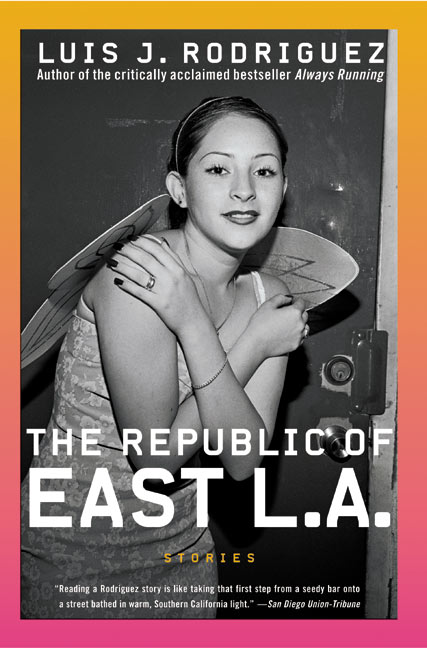
I read three stories from this collection: "My Ride, My Revolution," "Mechanics," and "Chain-Link Lover." All three focused on male protagonists who were struggling to succeed in some aspect of their lives -- mostly in love. Rodriguez's stories (at least, these three) took a closer look at the pressures and stressing factors at work on romantic relationships for these men; while this theme was fairly central to these stories, other ideas were at play as well.

"My Ride, My Revolution" dealt heavily with the idea of purpose -- the main character constantly questioned his purpose, his goals, the work he might do with his life instead of ending up beaten by the system and forced into low-paying dead-end jobs as he has been doing for his entire adult life. Compared to Chacon's stories in which the drive to break out of societal constraints and move life in a direction that's actually desired (oftentimes with the added element of anger), Rodriguez's stories feel much more trapped, cornered, and not-quite-but-nearly defeated. I'm not saying that he's presenting a hopeless portrayal of Chican@ life in the US; nope, I'm saying that his characters are struggling to stay afloat in a much more desperate way than Chacon's because, for the most part, they've lost their anger.

In "Chain-Link Lover" we see a counter-example for this trend. When the main character is confronted by a road-raging white truck driver threatening him with a tire iron, he remembers the mentally handicapped girl who loves him unconditionally and begins to feel real anger toward the man. He thinks of all the injustices or frustrations he's faced at the hands of others and draws them together to form a sort of fighting rage. However, while he is able to talk back to the driver and give him the "You want me? Come get me!" line, he also knows (and admits quite openly to the reader) that if the man decides to go through with his violence, it's a lost cause. In his big moment of bravery/bravado, this is how the narrative runs:
"'You want me? Come get me!' I prodded again, much braver now since I figured he didn't have the huevos. I knew most people didn't. It was something I counted on (but the day will come when I meet the vato who has what it takes to do exactly what he intends to do)." (157)
In other words, he is able to put on a brave face and make a hollow stand, but he's also very aware that he cannot follow through on his threats. I feel that there's a deeper political significance here, but I haven't figured out exactly where to go with that yet.

Finally, "Mechanics" presents a strangely optimistic/pessimistic outlook on love. The protagonist's entire life revolves around his wife and children until the day his wife leaves him. Then what? Well, then he realizes (over time) that her departure has actually freed him...but that he still loves his children immensely. I have no idea where to go with this, but it felt almost utterly hopeless.

I read three stories from this collection: "The Biggest City in the World," "Aztlán, Oregon," and "Too White." While all three were about different characters and had very different premises, there were some common themes running through them.

In "Aztlán, Oregon," the idea of institutionalized racism is really highlighted. The main character, a reporter named Ben who was once a gang member in Fresno but has since moved and become an anchorman, decides that he's going to do a radical political report on Chicano gangs. However, when he tries to talk to the gang members about the political conditions that may have contributed to their involvement in the gang, they shrug him off and continue talking about their own versions of the American Dream (wanting a decent house, a nice wife, etc.). Chacon focuses on the relationship between gang activity and contemporary American society, taking a critical look at the different ways kids (well-meaning kids, at that) end up involved in gangs. The issue comes up again in "Too White" when the main character, Joey, is forced to end his friendship with a white boy named Kenny in order to save his life. As Kenny rides away on his bike, Joey takes the beating that was originally meant for his ex-friend, only for Joey the beating takes on an entirely different meaning as evidenced by the last lines of the story:
"Through blurry eyes, I saw three figures standing over me. Then I felt the kicks all over my body, and I heard laughter. Then a sire. The cops were coming. They were all beating me, David, Johnny, Gilbert. I was the first to be jumped in." (134)
For Joey and his friends, there doesn't appear to be a way to bridge the racial divide between characters. The only solution is a violent reconciliation. Of course, in "Aztlán, Oregon" the violence that ends the story is of an entirely different nature: Ben beats up his supervisor (Brad) in a sort of cathartic outpouring of all of the emotions he's been keeping down in this city where he feels lost.

What, then, am I to do with "The Biggest City in the World" in light of these other two stories? In a similar manner, this story ends with the protagonist -- a timid college student named Harvey Gomez -- taking a cab ride to various locations in Mexico City when he knows he is flat broke. He makes a decision that will simultaneously allow him to experience his cultural heritage and also mean becoming a thief/cheat. Well, in many ways this is related to the other stories in a very significant way. Like Ben (who feels that he's lost his Chicano-ness) and Joey (who tries to navigate the gap between whites and Chicanos), Gomez begins to figure out what it means to him to be truly Mexican. After losing his wad of scholarship money -- a symbolic event that translates to a disconnection between Gomez and the Western institution -- he ends up being recognized by the cab driver (an "authentic" Mexican) as a "real" Mexican (this after Gomez's statement that he likes mariachi music).

Chacon's collection, from the three stories I read, seems to have a very specific political mission. The prevalence of gang issues and conflicting ideas of what it means to be Mexican, Chicano, or American are also critical, and Chacon seems to be writing for an audience who is struggling to work through these issues themselves.

Well, this collection is certainly very different from The Brief Wondrous Life of Oscar Wao. I guess that means it wasn't what I was expecting (meaning in part that it lacked any of the more supernatural or folkloric elements that Díaz's novel was so full of). In a way, yes, this was disappointing. However, the stories themselves were quite good.

I think the last story, "Negocios," was my favorite. It's not that it was that different from the others, it's just that it was longer and really dug into the complexities of immigration in a way that I haven't seen very often before. While the primary plot follows a man as he leaves his wife and children in the Dominican Republic and travels to the US (starting in Miami, then moving again to New York), it's a very internal journey. By this I mean that he experienced a lot of things that could be considered part of the archetypal US-immigrant narrative, but his thoughts and emotions regarding these experiences were what really made this story unique. On one level, he's fairly reprehensible (not really concerned with his familia in the DR, marrying a woman solely for the purpose of using her to attain citizenship, abandoning her and the son he has with her, etc.); on another level, his struggles and his journey illustrate the considerable strength of his character. I think this is where Díaz has really struck deeply into the idea of what it means to be an immigrant to this country -- of what it means to deal with racism and injustice and low wages and substandard living conditions and ridiculously long shifts...the list goes on.

The other stories were also good. I think Díaz covered an extraordinary amount of ground here. I mean, he has stories about teenagers in the US, children in the DR, laborers, students, etc. The story "Edison, New Jersey" for instance is about two men who assemble pool tables, and it's a fairly humorous story that doesn't deal with any huge, life-altering moments but does deal with the everyday issues that, when accumulated over time, can feel like life-altering moments. It also ends on a hopeful note.

Many of his stories deal with relationships between men -- friendships, but friendships that seem to run deeper than romantic relationships. I'll admit that the final lines of "Negocios" left me wondering about the father's relationship with his buddy, Chuito -- I think there are implications of their relationship being something more than friendship. After all, the narrative is given over to the son at the end, and he's talking about how he visited his father's second wife after his father had left his family as well. Then he goes on to describe the day his father came to get his familia from the DR and bring them back to NY, and he says:
"He bought a carton [of cigarettes] at a stand, knowing how expensive they would be abroad. The first subway station on Bond would have taken him to the airport and I like to think that he grabbed that first train, instead of what was more likely true, that he had gone out to Chuito's first, before flying south to get us." (208)
There's nothing major or scandalous here, but I think there is a subtle hint that Chuito was more important to his father than the familia was, and that his father ultimately chose Chuito over everyone else. It's small, but it's something that stood out to me -- by ending the story this way, Díaz left me wondering....

I found these two poems in an anthology called Hecho en Tejas: An Anthology of Texas Mexican Literature (pictured left).

I absolutely loved "Stupid America" because of the vehemence of the poetic voice and the personification of America as this sort of violent ignoramus who has to have pointed out to him the struggles of the Chican@ in America. It may be a short poem, but it has a big message to send. My favorite part is the ending:
remember that chicanito
flunking math and english
he is the picasso
of your western states
but he will die
with one thousand masterpieces
hanging only from his mind (176)
It just captures the profound sadness of this entire situation, where one person's genius could fail to be recognized simply because the system they live in refuses to recognize what they have to offer. Instead. that system buries it under grades and other measures that all culminate in one thing: the message that this person is worthless and has nothing to offer.

As for "The Chicano Manifesto" is also groundshaking. It touches on so many flaws in the system that I really became aware of when I was teaching at the high school level. I wish I could have my students read this poem now, because regardless of their racial composition, I think this poem is really important (especially in a place like California where there is such a large Chican@ population). The series of questions near the beginning of the poem are questions I've heard people say in various forms so many times:
what is it you chicanos want?
[...]
is it understanding?
is it that you want us to tolerate you?
is it admittance? (177)
When Delgado goes on to refute these questions, he makes so many excellent points. Understanding? Well, there's a huge difference between understanding and comprehending. It won't help. Tolerance? That just means you're putting up with someone -- tolerance does nothing to stop bigotry or racism or any of the problems from which discrimination arises. And admittance? Just asking that question situates one group on the "inside" and the other group (in this case, Chican@s) on the "outside." That's no good either. Delgado's poem really digs into the issue of race relations and points to some major flaws in the way mainstream (white) America tries to address the issue. It's a really worthwhile poem to read -- let me know what you think if you get the chance to read it.

Okay, I have to start by admitting that I thought this poem was going to be a book-length work, so I was really surprised when I discovered that it was really only a few pages long.

That being said, this poem blew me away. I feel like I need to go out and do some research on it, because it's really dense and complex, and I know I'm missing a large percentage of the references being made. However, I also know that the poem is extremely powerful. It's got a strong message to deliver about what it means to be Chican@, and what it means to really embrace one's past and bring it to bear on one's present.

I feel like anything I say is going to be inadequate. What I will say is that you should read this poem -- it's short, but it's really powerful. Give it a whirl and let me know what you think.

the distraction

Books. Reading. Words on a page. This is my magnificent distraction, a black and white obsession that has resulted in my pursuit of a PhD. This blog was born of a desire to write down my thoughts about the books on my reading list for the candidacy exams, and to share them with anyone who cares to read about them. Now it continues beyond that reading list (as my exams are behind me) and into the realm of my regular reading pursuits, whether they are for pleasureful or professional purposes. Enjoy!